
What Is CyberArk? A Beginner's Guide to the PAM Leader and the JumpServer Open-Source Alternative
Introduction
In cybersecurity, Identity Security is rapidly becoming the first line of defense for enterprise infrastructure. Industry statistics show that more than 80% of cyberattacks involve the abuse or theft of identity credentials. In this space, CyberArk stands out as a globally recognized leader in privileged access management software.
In 2025, Palo Alto Networks announced its plan to acquire CyberArk for approximately $25 billion, putting identity security at the center of the cybersecurity landscape. This article explains what CyberArk does, why the acquisition matters, and introduces JumpServer—a popular open-source alternative for teams that need cost-effective, transparent PAM.
We also cover how CyberArk and JumpServer fit into the broader market for remote access software, alongside tools like Linux system administration, authenticator apps for MFA, and even consumer-grade remote desktop tools such as RustDesk.
1. What Is CyberArk?
1.1 Company Overview
CyberArk Software Ltd. is an identity-security company headquartered in Petah Tikva, Israel. It was founded in 1999 by Udi Mokady and Alon N. Cohen, and went public on the NASDAQ in 2014 under the ticker CYBR. CyberArk serves many large enterprises across financial services, energy, retail, healthcare, and government.
The company’s core mission is to protect the most sensitive identities in an organization: privileged accounts. These accounts—owned by system administrators, database administrators, and cloud infrastructure operators—have far greater access than ordinary user accounts. If attackers compromise them, the entire organization is exposed. CyberArk exists to prevent that.
1.2 Core Technology Architecture
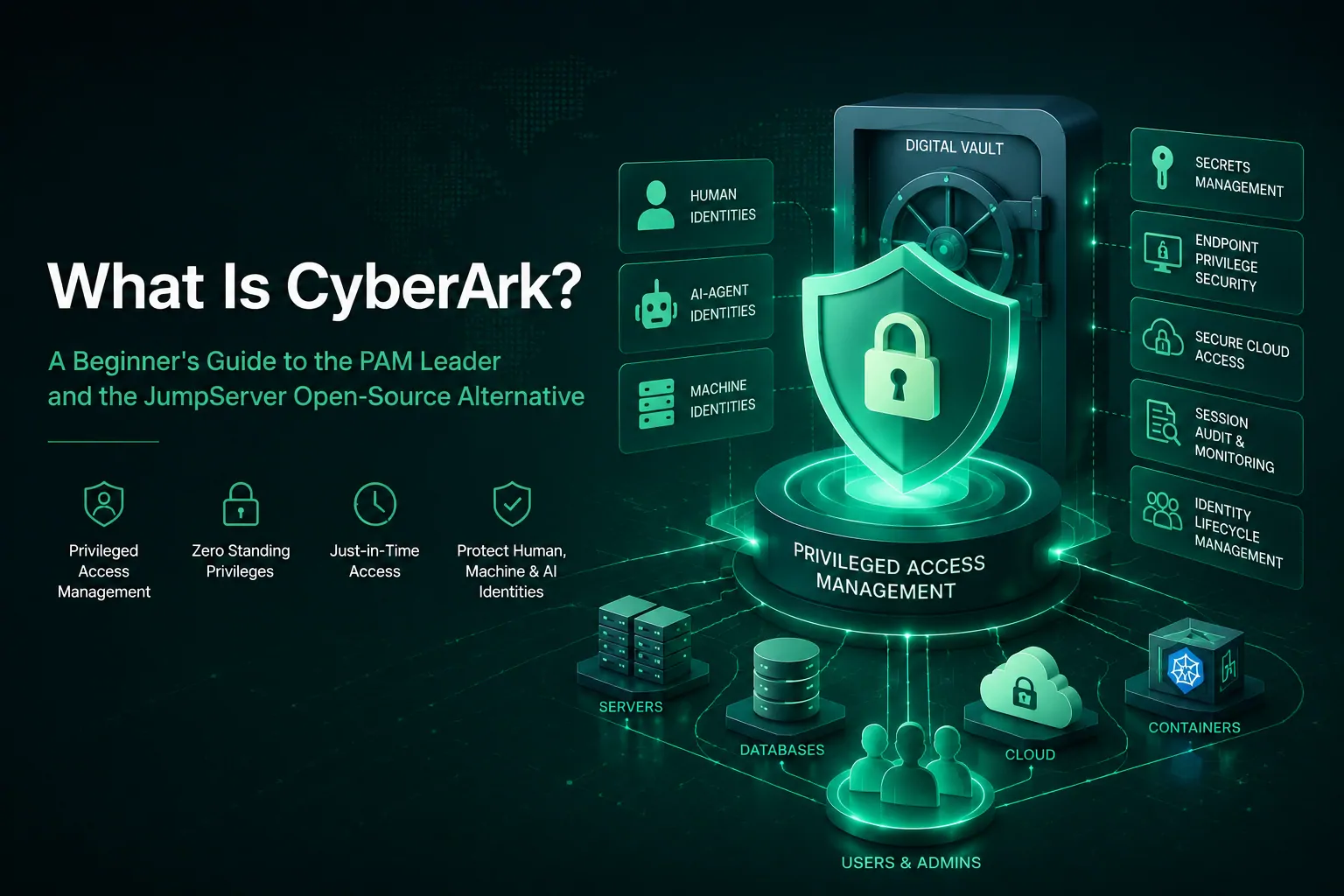
CyberArk’s platform is built on three foundational technologies:
| Core Component | Description |
|---|---|
| Digital Vault | ICSA-certified, multi-layer secure storage for privileged credentials, keys, and secrets |
| Privileged Session Manager (PSM) | Isolates, monitors, and records privileged sessions so high-risk actions are always traceable |
| Central Policy Manager (CPM) | Automates credential rotation and policy enforcement |
CyberArk follows two key security principles:
- Zero Standing Privileges: No one holds permanent privileged access by default.
- Just-in-Time (JIT) Access: The minimum required privileges are granted only when needed and automatically revoked afterward.
These principles align closely with the Zero Trust security model.
1.3 Product Portfolio
CyberArk’s identity security platform covers every type of identity:
- Privileged Access Management (PAM): Protects high-privilege IT and database accounts
- Endpoint Privilege Security: Manages local administrator rights on endpoints
- Secrets Management: Secures credentials used in CI/CD pipelines and microservices
- Secure Cloud Access: Protects identities and access across multi-cloud and hybrid environments
- Identity Lifecycle Management: Automates onboarding, transfer, and offboarding access changes
- Machine Identity Management: Manages TLS/SSL certificates, SSH keys, and other machine identities—expanded through the acquisition of Venafi
2. Palo Alto Networks Acquires CyberArk: A Market Shift
2.1 Transaction Details
On July 30, 2025, Palo Alto Networks (NYSE: PANW) announced its agreement to acquire CyberArk for approximately $25 billion—one of the largest cybersecurity acquisitions in history. The deal closed in February 2026, with CyberArk continuing to operate as a business unit within Palo Alto Networks.
2.2 Why the Acquisition Matters: Identity Security in the AI Era
Palo Alto Networks stated that the acquisition would create an end-to-end security platform for the AI era. As enterprises digitalize and adopt AI agents, identity becomes the new security perimeter:
- Human identities: employees, contractors, third-party partners
- Machine identities: servers, containers, microservices, IoT devices
- AI-agent identities: autonomous agents that access systems and data on behalf of users
Traditional network boundaries—firewalls and VPNs—are no longer sufficient. Integrating CyberArk’s identity security capabilities into Palo Alto Networks’ platform marks a fundamental shift from “protect the network” to “protect the identity.”
2.3 The New Brand: Idira
On May 12, 2026, Palo Alto Networks introduced Idira, the next-generation identity security platform. Idira consolidates and upgrades CyberArk’s capabilities to manage human, machine, and AI-agent identities and permissions from a single platform. It offers AI-driven risk discovery, zero standing privileges, and automated governance.
3. Challenges of CyberArk
Despite its leadership, CyberArk is not the right fit for every organization:
3.1 High Cost
CyberArk’s enterprise licensing and maintenance fees are substantial. For small and medium-sized enterprises (SMEs) or teams with limited budgets, CyberArk’s cost can be a significant barrier.
3.2 Complex Deployment and Operations
CyberArk is powerful but complex. Deploying the Digital Vault, configuring connectors, integrating with Active Directory, and managing MFA policies usually require dedicated, experienced staff.
3.3 Post-Acquisition Layoffs
After the acquisition closed in February 2026, Palo Alto Networks laid off more than 10% of CyberArk’s workforce, including staff in Israel and globally. This organizational transition may create uncertainty around product development and customer support.
4. JumpServer: An Open-Source PAM Alternative
For organizations seeking a cost-effective, transparent, and easy-to-deploy PAM solution, JumpServer is a strong alternative to CyberArk.
4.1 What Is JumpServer?
JumpServer (website: https://www.jumpserver.com) is a leading open-source bastion host and privileged access management software platform launched by the FIT2CLOUD team in 2014. Over 12 years, it has grown into one of the world’s most adopted open-source PAM projects, with more than 30,000 GitHub Stars, over 500,000 global deployments, and more than 3,000 paying enterprise customers.
JumpServer’s mission is to make enterprise security tools accessible to every organization—not just large corporations. Open-source code means transparency, auditability, and community-driven improvement: when the code is visible, security issues are found and fixed faster.
JumpServer offers two editions to suit different needs:
- Community Edition: Fully open-source and free under the GPL v3 license. It supports asset management below 5,000 nodes and includes all core PAM capabilities, making it ideal for small and medium-sized teams getting started.
- Enterprise Edition: Builds on the Community Edition with additional X-Pack features such as organization management, approval workflows, automated password rotation, and cloud asset synchronization. The X-Pack code is not open-source, and the JumpServer team provides professional support and ongoing maintenance.
4.2 Core Capabilities of JumpServer
Features marked X-Pack are exclusive to the Enterprise Edition. Unmarked features are available in both the Community Edition and the Enterprise Edition.
Authentication
| Feature | Description |
|---|---|
| Login Authentication | LDAP/AD, CAS, Passkey, RADIUS, SSO (OpenID, OAuth2, SAML2) |
| MFA | OTP, RADIUS secondary authentication; SMS authentication (X-Pack) |
| Login Review | Login behavior monitored and controlled by administrators (X-Pack) |
| Login Restrictions | IP black/white lists, login time windows (X-Pack) |
| Role Management | RBAC-based access control (X-Pack) |
Authorization
| Feature | Description |
|---|---|
| Multi-Dimensional Authorization | Fine-grained authorization across users, groups, assets, nodes, and accounts |
| Asset Authorization | Tree-based asset management with inheritance at node and child-node levels |
| Action Authorization | Control file upload/download, connection actions, and RDP clipboard behavior |
| Time Authorization | Restrict asset usage to specific time windows |
| Command Filtering | Granular control over commands executed on authorized accounts |
| File Management | SFTP and Web SFTP upload/download |
| Protocol Authorization | Control access by connection protocol |
| Ticket Workflows | Approval-based access control with two-level approval workflows (X-Pack) |
| Organization Management | Multi-organization management and permission isolation (X-Pack) |
| Access Control | Accept, deny, or review user connections to assets (X-Pack) |
Account Management
| Feature | Description |
|---|---|
| Account List | View all account information |
| Account Templates | Abstract shared accounts into templates for rapid asset association |
| Account Push | Push accounts to assets on scheduled tasks |
| External Vault | Integrate with HashiCorp Vault for secret storage (X-Pack) |
| Account Collection | Automatically collect host users on schedule (X-Pack) |
| Password Rotation | Rotate asset passwords in bulk with multiple policies (X-Pack) |
| Account Backup | Back up account information and send encrypted files via email (X-Pack) |
Audit
| Feature | Description |
|---|---|
| Session Auditing | Online and historical session review with optional watermarking |
| Recording Playback | Replay asset operation recordings; upload to public cloud storage |
| Command Auditing | Audit commands and alert on high-risk commands |
| File Transfer Auditing | Record file upload and download activity |
| Real-Time Monitoring | Administrators can watch sessions live and interrupt risky operations |
| Login Logs | Audit user login behavior and forward to Syslog |
| Operation Logs | Audit user operations |
| Password Change Logs | Audit password changes |
| Job Logs | Record automated task execution |
| Activity Logs | Timeline-based activity records for every resource |
Additional Capabilities
| Feature | Description |
|---|---|
| Multi-Protocol Support | SSH, RDP, VNC, Telnet, Kubernetes |
| Database Access | MariaDB, MySQL, Redis, MongoDB; Oracle, SQL Server, PostgreSQL, ClickHouse, DB2 (X-Pack) |
| Cloud Asset Sync | Synchronize assets from 23 cloud platforms including AWS, Azure, Google Cloud, Alibaba Cloud, Tencent Cloud, Huawei Cloud, and VMware (X-Pack) |
| Remote Applications | Manage remote applications and deploy application servers |
| Virtual Applications | Use Linux as a remote application server (X-Pack) |
| Job Center | Execute quick commands, scripts, and Ansible Playbooks on batches of assets |
| HD RDP | High-definition RDP client connections (X-Pack) |
| Cloud Storage for Recordings | Store recordings on Amazon S3, Tencent COS, Alibaba OSS, Huawei OBS, Ceph, Swift, Azure |
| Batch Transfer | Transfer files to multiple assets at once |
| AI Assistant | GPT-based intelligent Q&A |
| Branding | Custom logo and theme (X-Pack) |
4.3 JumpServer vs CyberArk Comparison
| Dimension | CyberArk | JumpServer |
|---|---|---|
| Licensing | Commercial subscription, high cost | Community Edition free and open-source; Enterprise Edition paid subscription |
| Deployment | SaaS or complex self-hosted | Docker one-command deployment; Kubernetes supported |
| Session Auditing | PSM recording | Proprietary recording format with Web replay |
| Multi-Tenancy | Requires additional licensing | Supported in Community Edition; full organization management in Enterprise Edition (X-Pack) |
| Cloud Asset Sync | Requires third-party integration | Community Edition includes basic support; Enterprise Edition supports 23 cloud platforms (X-Pack) |
| AI Capabilities | Idira platform supports AI identity management | Built-in GPT-powered Q&A assistant |
| Code Transparency | Commercial closed-source | Community Edition fully open-source and auditable |
| Community | Closed-source commercial ecosystem | 30,000+ GitHub Stars and an active global open-source community |
4.4 Why Choose JumpServer?
- Cost Control: The Community Edition is free, and the Enterprise Edition is priced far below CyberArk, making PAM accessible to teams of all sizes.
- Transparent and Auditable: The Community Edition is open-source under GPLv3, so security teams can inspect the code themselves.
- Fast Deployment: Launch a full environment with a single Docker Compose command, or deploy on Kubernetes, without lengthy architecture planning.
- Clear Feature Tiers: The Community Edition covers core bastion-host needs—multi-protocol proxying, session auditing, and command filtering. The Enterprise Edition adds X-Pack features such as organization management, ticket workflows, password rotation, and cloud asset synchronization for larger organizations.
- Multi-Cloud Ready: The Enterprise Edition supports automatic asset synchronization from 23 major cloud platforms, including AWS, Azure, Google Cloud, Alibaba Cloud, Tencent Cloud, Huawei Cloud, and VMware, making it well-suited for hybrid and multi-cloud environments.
5. Where JumpServer Fits in the Remote Access Ecosystem
Understanding CyberArk and JumpServer also means understanding how they compare to other categories of access remote software:
- Consumer remote desktop tools like RustDesk are designed for personal or ad-hoc support. They are easy to use but lack enterprise-grade session auditing, role-based access control, and credential vaulting.
- System administration tools for Linux and Windows servers are essential for daily operations, but they do not by themselves enforce least privilege or record every command.
- Authenticator apps and MFA tokens are critical for verifying user identity, but they are only one layer of defense and must be combined with privileged access controls.
- Privileged access management software like CyberArk and JumpServer ties these pieces together: they control who can access what, enforce MFA at the point of access, record and audit every session, and rotate credentials automatically.
For teams that need a production-grade PAM platform without the cost and complexity of CyberArk, JumpServer is a proven alternative.
6. Conclusion
CyberArk remains a pioneering and influential force in PAM. The Palo Alto Networks acquisition validates that identity security is now central to enterprise cybersecurity strategy. The launch of Idira shows that the market is moving toward unified identity management for humans, machines, and AI agents.
However, CyberArk’s high cost, complex deployment, and closed-source model make it unsuitable for every organization. JumpServer offers a credible, globally adopted open-source alternative with a free Community Edition, a feature-rich Enterprise Edition, and strong multi-cloud support.
Whether you are evaluating CyberArk or comparing privileged access management software, JumpServer is worth exploring.
Learn more: Visit https://www.jumpserver.com or the GitHub repository https://github.com/jumpserver/jumpserver
.webp)